

Article written by eminent Advocate Tirthankar Mukherjee
-National Chairman, Judicial Council
Editor, Asia 🌏 News
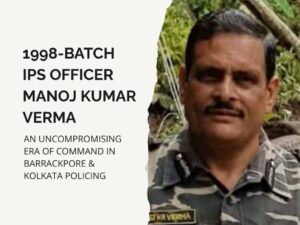
When Bengal’s policing ecosystem was in urgent need of firmness, clarity, and uncompromising administrative discipline, 1998-batch IPS officer Manoj Kumar Verma emerged as the officer who refused to dilute standards. His tenures as Commissioner of Police, Barrackpore, and later Commissioner of Police, Kolkata, were not routine postings — they were decisive restructurings of how policing should function.
Forged in Military Discipline — A Childhood That Created a Commander
Verma’s formative years were shaped in the disciplined environment of multiple Kendriya Vidyalayas and later the Military School in Belgaum, Karnataka. Growing up in Army cantonments instilled in him a deep sense of duty, punctuality, and uncompromising personal integrity.
As he revealed in a Facebook interview, his childhood was not just upbringing —
it was a training ground,
a crucible where discipline, structure, and operational clarity were forged.
Those raised in the shadow of olive-green don’t grow into laxity;
they grow into purpose.
Barrackpore & Kolkata: Where Policing Standards Were Reset
Verma’s leadership is defined by:
-
Zero tolerance for institutional complacency
-
Relentless enforcement of operational discipline
-
A results-first policing philosophy
-
A command style rooted in accountability, not excuses
In Barrackpore
He tightened operational structures in sensitive and historically volatile zones.
Where many looked away, Verma tightened the screws. His directive was unmistakable:
“Policing is not a negotiation. It either delivers results or it does not.”
In Kolkata
A city governed by political currents, public pressure, and emerging crime complexities needed a Commissioner who would confront challenges rather than cosmetically manage them.
Verma did exactly that:
-
Dismantled operational laxity
-
Enforced strict performance benchmarks
-
Made technology-driven surveillance non-negotiable
-
Increased internal accountability to eliminate complacency
Under his command, Kolkata Police witnessed a visible transformation —
institutional discipline began overshadowing bureaucratic inertia.
Jangal Mahal: The Turning Point of Hard-Edged Governance
Before his metropolitan leadership roles, Verma played a crucial part in the challenging terrain of Jangal Mahal, where policing requires courage, strategy, and psychological steadiness.
His approach blended enforcement with engagement:
-
Neutralising Maoist influence through precise intelligence operations
-
Building trust networks with local communities
-
Establishing a strong ground presence where the State was earlier only symbolic
-
Restoring administrative confidence in a fear-stricken region
Jangal Mahal needed a commander, not a caretaker.
Verma was exactly that.
IG Darjeeling: Restoring Stability in a Sensitive Region
As Inspector General, Darjeeling, Verma operated in a politically charged, ethnically diverse, and topographically challenging district.
His tenure was marked by:
-
Firm suppression of disruptive elements without alienating communities
-
Precision-led interventions during volatile moments
-
Reinforcement of administrative authority in agitation-prone areas
-
Steady rebuilding of public confidence through disciplined policing
In Darjeeling, where a single misstep could ignite instability,
Verma ensured that stability was non-negotiable.
Alignment With Supreme Court Doctrines: A Judicially Consistent Leadership
The Prakash Singh Mandate (2006): Structural Rigour in Policing
The Supreme Court emphasised:
-
Operational autonomy
-
Protection from external interference
-
Performance-based accountability
Verma’s leadership mirrored these principles with extraordinary consistency.
Rule of Law — K.T. Plantation v. State of Karnataka (2011)
Governance must be:
-
Predictable
-
Disciplined
-
Non-arbitrary
Verma’s intolerance for administrative arbitrariness and operational laxity stands firmly on this doctrine.
Constitutional Morality — Navtej Johar (2018) & NCT Delhi (2018)
This doctrine stresses:
-
Institutional integrity
-
Duty-based governance
-
Accountability as a constitutional value
Verma exemplified this by building systems — not personality-driven power structures.
Due Process & Procedural Fairness — Maneka Gandhi (1978)
His insistence on:
-
Technology-driven surveillance
-
Data-based decisions
-
Tight investigative timelines
-
Transparent procedural adherence
reflects what the judiciary calls “administrative fairness embedded in efficiency.”
Conclusion
Where others manage the system, Verma resets it.
Where others negotiate with disorder, he dismantles it.
Where others speak of reform, he implements it.
This is not just the story of an IPS officer.
It is the evolution of a commander —
forged by discipline, sharpened by duty, and defined by results.
 Asish Basak