

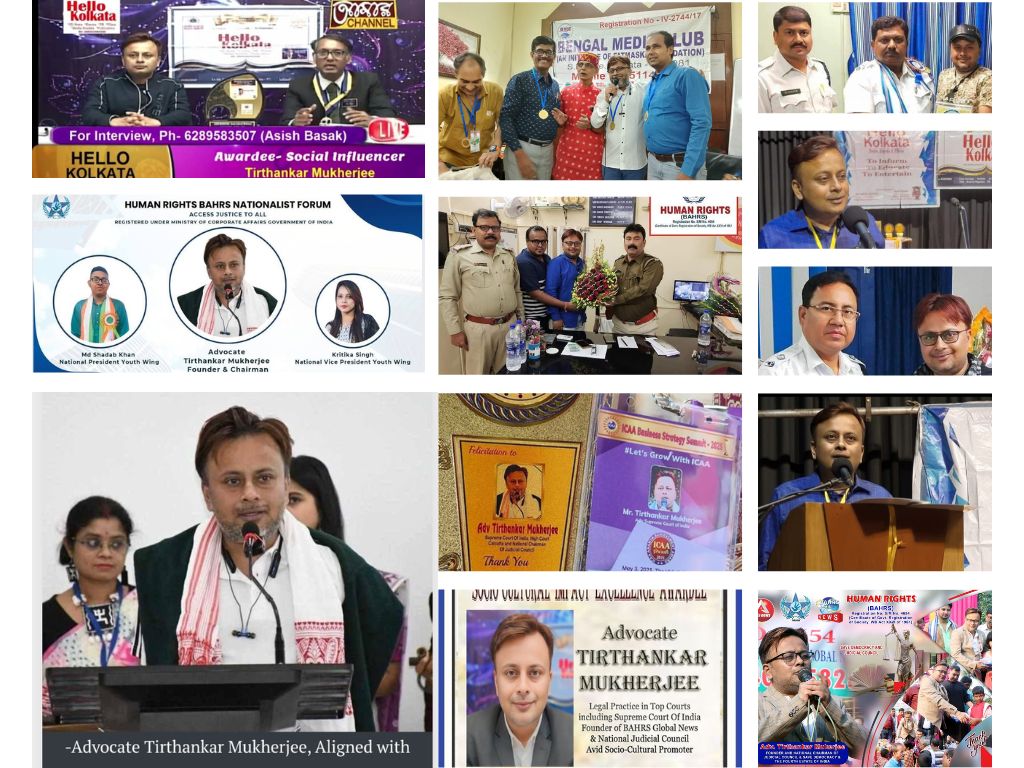
Advocate Tirthankar Mukherjee, National Chairman of the Judicial Council and National Chairman (Human Rights) of the BAHRS Nationalist Forum, continues to emerge as a significant force in India’s human rights and social justice landscape.
He is aligned with top courts like Supreme Court of India, Calcutta High Court and other cities across India.
An eminent legal scholar and human rights activist, Mukherjee’s work stands out for its rare integration of constitutional doctrine with sustained humanitarian action.
Constitutional Morality in Action
Mukherjee’s advocacy is deeply rooted in the constitutional vision articulated by the Supreme Court in landmark judgments such as Navtej Singh Johar v. Union of India (2018) and Justice K.S. Puttaswamy v. Union of India (2017), where dignity was recognised as the core of fundamental rights. Drawing from Maneka Gandhi v. Union of India (1978), his work reflects an expansive understanding of Article 21, affirming that the right to life includes the right to live with dignity, security, and autonomy.
Expanding Access to Justice
In line with Hussainara Khatoon v. State of Bihar (1979), which declared access to justice a fundamental right, Mukherjee has actively conducted legal awareness camps across regions. These initiatives educate citizens on FIR registration rights (Lalita Kumari v. Govt. of UP), arrest safeguards under Article 22 and DK Basu v. State of West Bengal, and protections available to women and vulnerable groups under laws such as the POCSO Act, Juvenile Justice Act, and ITPA. His efforts empower marginalized communities to assert their legal voice and rights.
Fighting Human Trafficking and Child Exploitation
Mukherjee has played a proactive role in combating human trafficking, guided by constitutional mandates under Articles 23, 39(e), and 39(f), and reinforced by judgments such as Vishal Jeet v. Union of India and Gaurav Jain v. Union of India. His on-ground interventions include rescue operations, coordination with enforcement agencies, and rehabilitation support for victims—particularly minors—reflecting the doctrine of parens patriae, where the state bears responsibility for protecting the vulnerable.
Protecting Children and Juveniles
Aligned with the “best interests of the child” principle under the Juvenile Justice framework and international conventions, Mukherjee’s work draws strength from cases like Sheela Barse v. Union of India, M.C. Mehta v. State of Tamil Nadu, and Sampurna Behura v. Union of India. His initiatives ensure humane treatment, rehabilitation, and reintegration of children, viewing them as individuals in need of care rather than punishment.
Campaigns Against Drugs, Child Marriage and Cyber Fraud
Mukherjee has also led strong campaigns against drug abuse, child marriage, and cyber fraud. His anti-drug initiatives emphasize strict compliance with the NDPS Act, informed by rulings such as State of Punjab v. Baldev Singh and Tofan Singh v. State of Tamil Nadu.
In the fight against child marriage, his interventions uphold the Prohibition of Child Marriage Act, the Right to Education, and Article 24, echoing the Supreme Court’s stance in Independent Thought v. Union of India (2017).
Addressing the rising threat of cyber fraud and so-called “digital arrest” scams, Mukherjee’s awareness drives rely on the IT Act and constitutional privacy principles, educating citizens on digital safety and informed consent.
Humanitarian Outreach and Right to Health
Beyond legal advocacy, Mukherjee’s humanitarian service extends to rescuing children from labour and begging rackets, supporting destitute populations, and organizing health camps for marginalized communities. His work resonates with landmark judgments such as Olga Tellis v. Bombay Municipal Corporation, Paschim Banga Khet Mazdoor Samity v. State of West Bengal, and PUCL v. Union of India, affirming the right to food, shelter, and healthcare as integral to a dignified life.
A Life Dedicated to Living Constitutionalism
Legal observers note that Tirthankar Mukherjee represents a model of “living constitutionalism,” where judicial principles are not confined to courtrooms but actively applied in society. By transforming doctrine into duty, his work underscores a fundamental truth of Indian constitutionalism—that rights must be lived, protected, and realized on the ground.
Widely regarded as a guardian of the vulnerable and a catalyst for public empowerment, Mukherjee’s contributions continue to reinforce the idea that the welfare of the people remains the supreme law.

— Article written by Amrit Singh
 Asish Basak