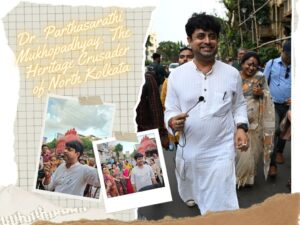

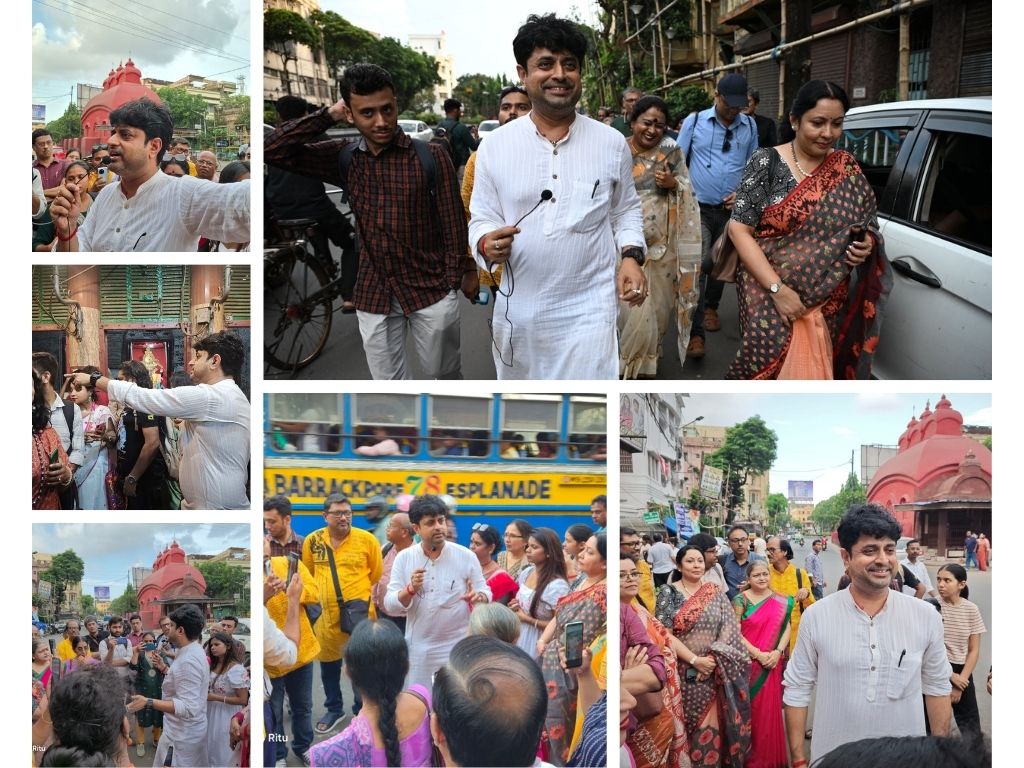
When an internationally trained kidney specialist, fresh from London, chose to walk people through the narrow lanes of North Kolkata—Bagbazar, Sutanuti, the ghats of the Ganga, and the temples of Kumartuli—friends and family were surprised. But Dr. Parthasarathi Mukhopadhyay, unwavering in his conviction, declared that while medicine was his profession, his beloved city, Tilottama (Kolkata), also deserved his time and voice. “If no one raises concern for its heritage, history, and culture, and if the next generation is not taught to love their city, then Kolkata will turn into ruins, and Bengalis will lose the roots of their cultural pride. Our very essence of Bangaliyana will be lost,” he had said.
Born into a prominent aristocratic family of Bagbazar, Dr. Mukhopadhyay had long envisioned a cultural revival. He founded the Bengal Forum for Intellect and Culture, an international online platform uniting Bengalis across the globe. Through this initiative, he brought together descendants of Bengal’s great families, as well as the custodians of household Durga Pujas, and drew attention to centuries-old rural and district Pujas that had fallen into neglect.
Four years ago, in the post-pandemic period, he introduced the “Best Bonedi Bari Pujo Sharad Samman – Hall of Fame”, a unique effort to celebrate aristocratic family Pujas and distinguish them from themed community Pujas. He personally guided UNESCO officials to show them how these traditional Pujas represented Bengal’s living heritage. He also curated archives of ancestral homes of eminent Bengalis, many of which now stand neglected, urging people to remember: “Stay well, stay Bengali. We have seen Hinduvadis, Marxists, and Feminists—now it’s time to be Bangalibadis.”
Why did Dr. Mukhopadhyay choose Bagbazar and Kumartuli as his center of activity? “Because this is the nucleus of our aristocracy and the cradle of Bengali history,” he explains. From women clay artisans to the story of Rasgulla, from Sutanuti’s ghats to Jatra plays, from the first community Pujas to the roots of theatre, from the last repair shop for radios to legendary cutlets and chops, from Madan Mohan Temple to the ancient Dhakeshwari shrine—this soil carries the footsteps of countless great souls. “It is like a whole world within Kolkata itself,” he adds.
Time and again, he has brought visitors from across India and abroad to these alleys to experience the “real” Kolkata. In numerous media interviews, he has appealed to UNESCO to declare Bagbazar–Kumartuli–Sutanuti as a special Heritage Zone.
Perhaps in 2025, when New Delhi honors him as the “Best Bengali,” Dr. Mukhopadhyay’s dream will come closer to reality. Until then, the spark he ignites in the hearts of nearly forty young Bengalis from around the world—sharing laughter over Mitra Café chops and KC Das Rasgullas by the Ganga—keeps the spirit alive.
In these trying times for Bengal, it is thanks to the vision and passion of a London-returned doctor that a fresh wave of love for Kolkata is being born.